F:\FIELDWORK\DISPATCHES\TEST_2_DISPATCHES
Notes on the Birth of Korean Cool
‹ Back to DISPATCHES\ 2026-06-16
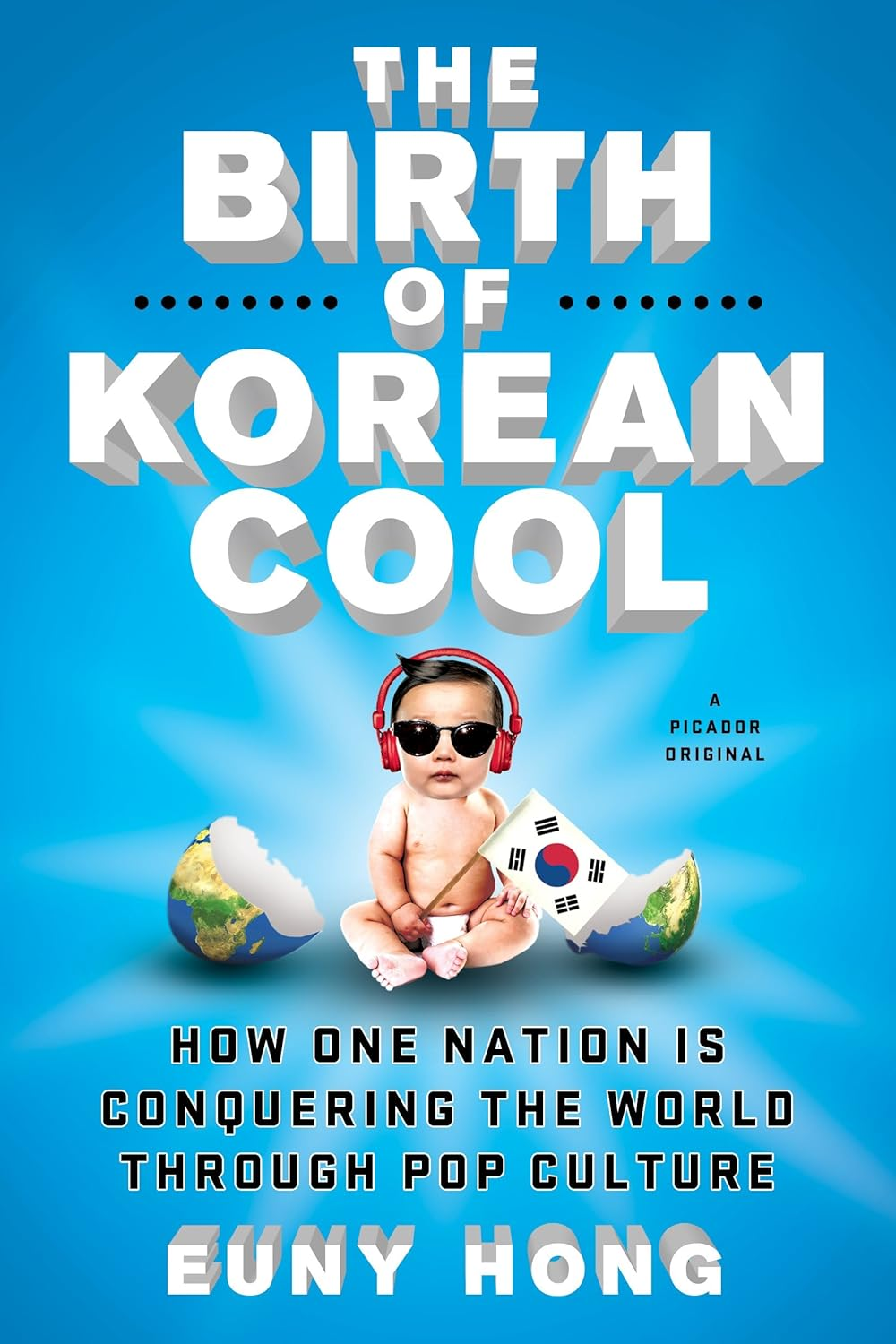
Just finished reading The Birth of Korean Cool, Euny Hong's 2014 account of how South Korea went from backwater to trendsetter.
Dated, but an incredible and breezily readable intro to Korea’s transformation after the Asian financial crisis.
This is the book to read if you’re not familiar with K-culture, K-pop, or K-anything.
What I’m struck by is how the Korean Wave (hallyu) is the result of the same perfectionist tendencies that inform the rest of Korean culture.
It’s interesting to consider how Americans revile certain boy bands and record labels for manufacturing hits, when all of Kpop is a manufactured phenomenon — and yet, no less popular for it. One country’s factory output is another’s sense of cool.
On the other hand, I would imagine most Kpop consumers these days are well aware of Kpop being a manufactured thing and tbh don’t give a shit. Hyperprocessed audio stims. Maybe this speaks to the power of fan culture over authenticity? Or belonging as the product?
Below, some of my favorite excerpts, grouped into themes (more or less).
All from Kindle so apologies for the lack of page numbers.
-s.
On the IMF Crisis as Turning Point
The financial crisis—which started in Thailand and was caused by a perfect storm of bad debt, lender panic, and regional contagion—affected most of Asia, including South Korea. In December 1997, the Korean government negotiated a loan of up to $57 billion from the International Monetary Fund. (They ended up using only $19.5 billion.) The day they made the loan request was called the Day of National Humility. President Kim Young-sam told his country via television that he was "whipping himself every day" in shame at having brought his country to this situation. (Location 1084)
Another huge shift was that Korean youth felt emboldened to be entrepreneurs. "Before the crisis, students were students," said Lee. "After the crisis, a lot of young people started businesses." He cites the example of Lee Jae-woong, the founder of Daum Communications, the company that created one of the world's first user-generated web portals. When Lee first started the company in 1995, he was fresh out of graduate school. But when the crisis hit Korea, he faced a choice: fold—or do something crazy. He went for crazy. TH Lee explained, "He sold company stock on the street. He said if you buy our shares, we'll buy you a winter coat. That was a crisis situation. Now he is a very rich man." In 2012, Daum earned about half a billion dollars in revenue. (Location 1114)
Korea made some of its best decisions in the wake of the crisis. Its information technology, pop, drama, film, and video game industries as we know them today all arose out of a last-chance, long-shot gamble to get out of this hole. (Location 1121)
The IMF crisis had revealed a fault line in the Korean economy: the nation had become overly reliant on the chaebols—the mega conglomerates. This meant that if the chaebols fell, so fell the nation. Korea has no natural resources and very little arable land. Compounding the problem is that labor costs have risen so dramatically in the last twenty years that the country cannot rely solely on manufacturing as a source of wealth. (Location 1130)
Korea is held back by an additional political handicap. According to a Korean economist who is also my dad, Korea is lacking in one huge technological advantage from which nearly every other industrialized nation has benefited for years: the option of letting the military lead the technological curve. "Since World War II," he said, "countries have been investing heavily in technology for military and defense, and the research they produced trickles down to the private sector." (Location 1134)
By contrast, Korea is not permitted to pursue military technology on an aggressive scale. In accordance with the 1953 mutual defense treaty between South Korea and the United States, South Korea cannot make any major military decisions without U.S. support. In other words, Korea can't compete with the big technological players in certain areas. Thus it has been forced to focus elsewhere. (Location 1139)
On Han: Inherited Grievance as National Engine
In order to understand the Korean drive that propelled the country to wealth, you have to know that Korea has been the whipping boy of fate for five thousand years. The peninsula has been invaded four hundred times in its history, and it has never once invaded any other nation, unless you count its participation in the Vietnam War.1 (Location 612)
The result of all this abuse is a culturally specific, ultra-distilled form of rage, which Koreans call han. I usually find it pretentious when someone says that a particular word is untranslatable, but han really is untranslatable. By definition, only Koreans have han, which arises from the fact that the universe can never pay off this debt to them, not ever. (Koreans are not known for being forgiving.) (Location 616)
As Korean film director Park Chan-wook (Oldboy, Stoker) told me, "Han only occurs when you cannot achieve proper vengeance, when your vengeance is not successful." (It is worth mentioning, however, that Park emphatically denies that his movies are about han.) (Location 620)
But Koreans do not consider han to be a drawback. It's not on the list of traits they want to change about themselves. (Location 626)
The word han came up several times during the course of my interviews for this book. When I asked the co-creator of the popular Korean soap opera Winter Sonata, Kim Eun-hye, why Korean dramas contained so much human misery, she said, "Well, you know, Koreans have a lot of han." (Location 627)
It's the opposite of karma. Karma can be worked off from life to life. With han, the suffering never lessens; rather, it accumulates and gets passed on. Imagine the story of Job, except when God gives him a new family and new riches, he has to relive his suffering over and over again. (Location 631)
the persistence of han is Korea's emblematic song—not the national anthem, but the song that represents Korea more than any other: a folk song called "Arirang." It's so old that no one really knows how old it is. It's so universally Korean, in fact, that even North Koreans play it on their news broadcasts and consider it a symbol of their nation, too. The gigantic mass spectacle North Korea hosts every year is called the Arirang Games. (Location 633)
What is this song about? In verse one, a spurned lover says, "Ye who hast tossed me aside and left me, I hope you get a foot disease before you have traveled ten li." (The (Location 637)
Han reminds me of Carl Jung's concept of racial memory—the idea that the collective experiences of a race are hereditary. Thus, the memories of our ancestors are encoded in our DNA, or at least in our unconscious. The neuroses the current generation endures is because of the suffering of their ancestors. (Location 640)
What I found astonishing in the course of researching this book is that many Koreans ascribe Korean success to han. It makes sense, in a way. A race that has been under constant threat knows it can survive anything. (Location 649)
On the Rivalry with Japan
Korea's more recent grievances against Japan stem from the fact that Japan invaded Korea and colonized it from 1910 to 1945. During this time, Japan famously forced Koreans into involuntary manual labor; thousands of Korean women were forced to become "comfort women"—sex slaves of Japanese military officers. (The Japanese government officially apologized in 1993, but in December 2012, Prime Minister Shinzo Abe threatened to retract the apology.) (Location 652)
Dokdo had no official permanent residents until 1981, when a Korean octopus fisherman living in nearby Ulleung Island was so incensed by Japan's continuing claims on Dokdo that he made his permanent home there. A handful of Koreans choose to live there—no more than four in total at any given time—purely as a patriotic gesture. (Location 671)
As someone told me, "Is it really a coincidence that every time North Korea tests missiles, it always happens to be over Japan?" (Location 694)
During the tournament, some matches were held in Japan; some in Korea. The players had to fly back and forth between the countries. It was deeply annoying for everyone. FIFA realized its initial error of judgment, and in 2004 made it illegal for multiple countries to cohost the World Cup. (Location 715)
What does this have to do with the Korean Wave, you ask? Though many Koreans would not like to admit it, a lot of their drive and motivation arose from a desire to beat Japan at something, anything. In the 1980s, all of Asia had benchmarked Japan as the nation to aspire to economically. Currently, only Korea is succeeding. And han has a lot to do with it. In the late 1990s, Samsung had set its sights on the Japanese electronics giant Sony as the company to beat. Not IBM, not Microsoft, not Apple, but Sony. (Location 726)
We were among the first schools to ban school uniforms, which were seen as an imprisoning holdover from the period of Japanese colonial rule, which lasted from 1910 to 1945. (Location 204)
On the Hallyu Machine: Building K-pop from Scratch
A Korean record label will spend five to seven years grooming a future K-pop star. This is why some Korean artists sign the thirteen-year contracts binding them to indentured servitude; the first half of that period is spent on training, and the company can't reap the rewards of its investment unless the artist stays on past the incubation period. (Location 109)
Yes, it's true that K-pop labels recruit budding child stars and bind them to ironclad contracts that can last as long as thirteen years. What you have to understand, though, is that Korea had no other way of building a pop industry. (Location 1388)
This was never going to happen in Korea. Kids didn't have the free time to jam with friends or form bands. They were studying all the time. All the time. And if they weren't studying, it was likely because they were helping their parents run the family business. If Korea wanted a pop music industry, it was going to have to create it from the ground up. It didn't have time to wait around for four random geniuses to meet on their own on the streets of Liverpool or at some pub. (Location 1396)
Furthermore, there is one major difference in western versus Korean culture: western kids can goof off. In the unforgiving Confucian culture of Korea, however, a young person who screws up has a hard time getting back on track. There aren't really any second chances. Up until the last ten years or so, when K-pop started to prove hugely profitable, no Koreans would have risked their future to try to strike out on their own as a musician. If a Korean music industry was to form, it didn't have time to wait for the Korean John, Paul, George, and Ringo to magically find each other. (Location 1404)
On the one hand, the stringent contracts are indeed part of Hallyu's success—the performers dance and sing well because they're recruited young and trained for years. On the other hand, the TVXQ! contract reveals that the band is paid shockingly poorly compared to top American bands. The artists don't get a guaranteed percentage of album sales until fifty thousand units have sold.1 (Location 1422)
"That's how the west sees all of Asia, not just K-pop," says culture critic Lee Moon-won. "They think we're all robots. We can't do anything about the fact that the west sees us that way. Koreans spend the same effort on everything, whether it's college entrance exams or an office job. Korea stands for hard work." (Location 1430)
the star-making process is so unpleasant that there are not many countries whose aspiring stars would put up with it. Korean youth, meanwhile, are used to intense sadomasochistic academic pressure, extreme discipline, constant criticism, and zero sleep. (Location 1501)
Speaking of the company, Shin said, "There is no equivalent in other countries." He's not kidding. CJ E&M is the quintessential Korean pop culture company in that it is made up of completely integrated units that all feed off each other in a highly efficient, highly profitable ecosystem. Its divisions include music television (such as MNET), film distribution, live entertainment (they staged Mamma Mia in China), video games, and "smart media," which is basically a social media web 2.0 platform for marketing all of the above. When CJ E&M puts on a concert, it also simultaneously releases a music video game and a dance video game related to the concert's theme. This sort of "one hand washes the other" model is what Korea has become known for. (Location 1489)
It seemed like a sudden and abrupt change, as if Korea had suddenly decided to go off the metric system or drive on the other side of the road. MNET, which launched in 1997, was instrumental in changing the Korean public's view of the entertainment industry. Just as MTV changed the way Americans thought of music, so MNET transformed the song-based product into a video-based one. (Location 1515)
A staggering 4 percent of the population of South Korea auditioned in 2012 for Superstar K, Korea's biggest televised singing competition. That's 2.08 million would-be K-pop stars competing in a single year in a country with a population of 50 million. (Location 1473)
What this attests to is that the Hallyu Wave, and the Korean government's strategy to capitalize on it, has caused a tectonic shift in how young Koreans are viewing their future. (Location 1476)
On the K-pop Aesthetic and Its Export Formula
Dancing well isn't enough. K-pop band members must dance in perfect synch, like clockwork. If you've ever seen a K-pop video, you'll notice that while no one is Baryshnikov, they do have split-second precision. And in order to achieve that, you have to put the band together while they're still young and hold off their debut until they've learned to act as one. (Location 1528)
The songs and videos focus on the singers and not on the musicians; there are no instrumental solos. As for the look of the K-pop video, it's worth noting that Psy's "Gangnam Style" is very atypical in that it uses real street scenes and real locations, mostly unadorned. The setting of most K-pop videos, by contrast, is sparse, futuristic, and sometimes wintry, like a space-age version of a Chekhov play. The girls always smile; the boys never do, instead bearing warrior expressions. Everyone is brutally attractive. (Location 1535)
Korean music producers have found that large groups acting in unison are catnip to fans. (Location 1540)
K-pop executives always have an eye on foreign markets, and adaptability to different cultures is part of the formula. Many K-pop bands release songs in Chinese or Japanese, like Girls' Generation's "Paparazzi" (nothing to do with Lady Gaga), recorded in Japanese. TVXQ!'s entire marketing strategy is based on appealing to Japan. Boy band Super Junior has a Chinese subunit, called Super Junior M, featuring two Chinese members. Many bands, like the girl group 2NE1, have Korean Americans so that the English sounds authentic. Clearly, the system works. (Location 1550)
The big unanswered question in K-pop is whether it can conquer the United States. Pop critic Lee Moon-won thinks so. "Something has changed in the United States. The Reagan era was the last time that the U.S. was exclusively into themselves. Before that, in the 1960s, foreign art house movies did really well in the United States. After that, in the 1970s and 1980s, at the height of the cold war, [the self-centeredness] was bad. Especially under Reagan. After Reagan, they became more open to other cultures." (Location 1573)
"We think sometimes bands will try to go for humor in their videos, but it's ehgyo [cutesy baby talk] humor. Ehgyo humor is not easily understood [outside Asia]." She's right. It's not. It's sort of a setup in which a girl infantilizes herself as a means of light flirtation, and you can't tell whether she is talking to her older brother or her boyfriend. It's not quite French-style sexy-baby, like France Gall or Brigitte Bardot; it's more innocent, like a petulant child. (Location 1583)
On the Engineered Nation: The Developmental State and "Cultural Technology"
Korea has multiple five-year plans, the likes of which most democratic and capitalist countries have never seen. The government felt that spreading Korean culture worldwide was dependent on Internet ubiquity, so they subsidized Internet access for the poor, the elderly, and the disabled. Currently, the government is wiring every single household with a 1 gigabit-per-second connection—which would make it two hundred times faster than the average Internet connection in the United States. South Korea learned from having to rebuild its country after the Korean War (1950–1953) that if you're going to make change, the change has to be drastic, it has to be fast, and it has to be for everyone. E-mail is useless if only a few people have it. (Location 103)
The South Korean economy is a paradox: it is utterly capitalist, yet at the same time it is in some ways still a command economy. (Location 112)
In 2012, government funds constituted over 25 percent of all venture capital money disbursed in Korea.1 A mind-boggling one-third of venture capital in Korea is spent on the entertainment industry—more than on any other sector. (Location 115)
in 2009, when the South Korean record industry was suffering a loss in revenue because of illegal music downloads, the government allocated $91 million to rescue K-pop. The plan included building a K-pop center with a three-thousand-seat concert hall (a work in progress) and regulating the nation's noraebangs—karaoke rooms—to make sure the owners are paying royalties for all the songs in their machines. (Location 118)
Imagine the top levels of government working on virtual reality and hyperrealistic hologram technology—but not for the purpose of warfare or espionage; rather, to make a mind-blowing concert experience. That's one of the projects undertaken by the Ministry of Culture, Sport, and Tourism. (Location 1171)
director of the Popular Culture Industry Division. (Location 1174)
One of Choi's division's roles is to promote the research and development of highly advanced "cultural technology." I'd never heard that term before, but according to Choi, Hallyu depends on it and the government invests a great deal on it. (Location 1180)
These technological feats are developed in cooperation with ETRI—Electronics and Telecommunications Research Institute—a Korean think tank and technology lab in the southern city of Daejon. They also work with the Korean Culture Technology Institute, a research and development laboratory dedicated to Korean culture technology, based in the southwestern province of Gwangju. Both are government-owned. Yeah. The Korean government owns the local equivalent of Industrial Light and Magic. (Location 1185)
Many other countries have government arts funding, but how many governments finance popular culture—or create a $1 billion investment fund to nurture it? (Location 1192)
The ministry has three other cultural content industry divisions: one for video games, one for television, and one for cultural industry policy. (Location 1194)
Collectively, they are called the Cultural Content Office. (Location 1195)
Every time someone sings a song in a noraebang, or karaoke room, the artist is supposed to receive royalties. Choi's division writes those policies. (Location 1198)
an investment fund—not to give free grants, but a for-profit fund, very much aimed at making high returns. Currently the fund size is a staggering $1 billion. That entire fund is earmarked just for the Korean pop culture industry; it does not include the fine arts like museums, opera, or ballet. (Those industries are run by an entirely separate division. Koreans take culture very seriously.) (Location 1205)
To that end, the noraebangs are legally classified into three types: One type is not permitted to sell alcohol, but some owners sell it illegally anyway, so the government tries to monitor this. The second kind is allowed to sell alcohol. And the third kind, said Choi, blushing as he did so, "is the one where you can be with women." The Koreans call the third type a "room salon." Choi's ministry only concerns itself with the first kind of noraebang; the latter two are regulated by the police bureau and the Ministry of Welfare and Health. Who knew that karaoke rooms required so much bureaucratic hassle and such a staggeringly complex taxonomy? For that matter, who knew that karaoke rooms were such a popular sex worker hangout? (Location 1215)
Hallyu World, a multicomplex theme park, in Ilsan, a town northwest of Seoul. (Location 1222)
On the Branding of a Nation and the Strategy of Reach
Right now, the third-world countries are too poor for most western nations to care about. This is where Korea has a peculiar, unreproducible advantage over every single other nation that has been a global pop culture power: it was once a third-world country. Thus Korea understands the stages of other nations' development; it has carefully studied these cultures to determine what kinds of "K-culture" products would be most favored there. And Korean economists are hard at work gauging the rate at which these nations will become wealthier and have more purchasing power. You can bet that once the citizens of these countries are able to afford to buy mobile phones and washing machines, they'll buy Korean brands. Why? They're already hooked on Korea the Brand.
Korea is upending the widely held belief that trying too hard to be cool makes you uncool. (Location 124)
Korea was the first nation in the world to install Internet access in 100 percent of all primary, middle, and high schools.8 (Location 600)
On Confucianism and the Logic of Social Order
in Korea, where the Confucian belief that all virtue stems from filial piety holds sway, not getting along with one's parents is quite a big deal. (Location 300)
Without knowing which party is older, no one knows how to act or speak. (Location 809)
The Chosun Dynasty adopted Confucianism in all walks of civil and personal life at the beginning of the fifteenth century. The nation's kings were worried about losing power and sought a drastic solution to obliterate the two biggest threats: chaotic class warfare and the increasingly influential Buddhist clerics. Since the system favored those already in power, it was a no-lose proposition for the monarchs. (Location 819)
Confucianism didn't really get into full swing in Korea until its second wave—called neo-Confucianism—in the fourteenth century AD. (Location 461)
The rulers adopted neo-Confucianism partly as an excuse to overthrow the old aristocracy (with whom they were fed up). Under this new system, anyone could become an aristocrat. All they had to do was pass an excruciating civil service exam, called the kwako.3 In other words, the Korean political system was a meritocratic aristocracy—what an incredible oxymoron. (Location 463)
If you passed it, you were instantly given the title of yangban—you became an aristocrat. Not only that, but your whole family line was upgraded in the process. There's a catch, though. A big one. Your male heirs have to pass the kwako exam as well. If your descendants failed the exam three generations in a row, you and your family were stripped of the yangban title and went back to being nobodies. (Location 469)
The current practice that] the parents decide everything or the husband decides everything is a misinterpretation of the Confucian concept," Lee explained. He has very good reasons for his surprisingly frank views on the matter. He suffered the raw end of the system when he started dating the Korean woman who became his wife. When he first came to Korea in 1978, it was unthinkable for a Korean to marry a foreigner. It's more acceptable now but still frowned upon. (Location 846)
In Confucianism as practiced in Korea, a person's identity is determined by the male side of the family. Your ancestry is recorded in a hojok, a record of lineage. Traditionally, a non-Korean male could not be in the hojok, nor could any of his descendants. Using the same logic, illegitimate children could not be in the hojok unless the father declared his paternity. These hojok restrictions were not completely eliminated until 2005; it took three more years to officially implement the change. (Location 849)
In Korea, if you were not in the hojok, you did not exist as a Korean citizen. You had about as much status as an illegal immigrant. You could not inherit your parents' assets after their death. It would be difficult to find a job. (Location 856)
This points to a crucial difference between Korean and western culture. As Lee succinctly puts it: "There is no 'bad boy' model in Korea. Everyone is a chak han kid." A chak han kid is a good kid, with the implication of innocence. It's different from simply being "good." A philanthropist giving millions of dollars to a charity is performing a good deed, but it is not a chak han deed. A kid who helps his grandmother with the washing up is doing a chak han deed. It is on a smaller scale than goodness, and it refers more to conforming with traditional social values rather than spiritual or metaphysical goodness. (Location 1447)
On Education, Exams, and the Stakes of Childhood
The anchor of the Korean education system is the millennia-old Confucian belief that teachers are benevolent beings who guide you through your measly existence, and if you don't obey them, your life will be ruined. (Location 376)
Korean culture views childhood as an extremely high-stakes period. If you screw up your early years, you are finished, finished, finished. There's an old Korean saying that I heard often: "A habit begun at age three lasts until age eighty." (Location 400)
This reveals another cultural bias: in Korea, getting bad marks at school is tantamount to juvenile delinquency. It's also a direct act of disrespect toward one's parents, a core violation of Korean society's ethical system. (Location 306)
Comparing welts the day after report cards were sent home was a popular recess pastime in my class. (Location 318)
paying off teachers was a normal practice. It still is. (Location 419)
My eighth-grade homeroom teacher hit every single student in the class after exams. It wasn't because of overall poor performance. It was just something she always did. The number of times students got hit equaled the number of their class ranking in the exams: the top-scoring student got hit once; the second-ranking student got hit twice, and so on until the final student got hit sixty times. (Location 426)
Corporal punishment in Korea has been phased out over the last decade, and it became officially illegal in 2011—but there are loopholes. (Location 430)
"In the old days," she said, "the teacher was often much more educated than most of the parents. So the parents entrusted their children to the teachers. Some mothers would bring their own sticks to the teacher and say, 'Please use this to hit my child.' " (Location 443)
Apparently, such an instrument was called "the stick of love." (Location 446)
The reason why Korean schoolteachers don't command as much respect as before is that for the last decade, Korean students have given their attention to private after-school learning centers, called hakwons. It's an open secret that students pay less attention to their public schoolteachers now because their hakwon studies have put them way, way ahead of the syllabus. (Location 481)
The government viewed private lessons as a dangerous threat to the level playing field, as wealthy families would have a major advantage in getting their kids into top universities. The ban on private tutoring was officially lifted in the late 1990s, largely because it was impossible to enforce. (Location 491)
According to Kim Young-sun, 2.8 percent of the Korean GDP is spent on hakwons. To give a sense of how huge 2.8 percent is, that's over half of what Korea spends on its entire public K–12 education system.4 (Location 494)
According a 2012 report on education issued by the Pearson publishing group, "The [Korean] government has become so worried about the extent of these studies that it has banned hagwons from being open after 10pm, but still needs to send out patrols to shut down those which mask illegal, after-hour teaching by posing as self-study libraries." (Location 499)
In other words, there are study-easies. Like speakeasies, but for studyholics. (Location 503)
Another problem: there's something in the air at hakwons that gives rise to a surreal level of cheating and corruption. "In some ways, the shadiest business in Korea is the education business," says Sid Kim. (Location 506)
In May 2013, the U.S. College Board canceled an SAT exam scheduled in Korea. It was the first time in the entire history of the College Board that it had canceled an exam for an entire country. The reason: mass cheating. The cheating had occurred at over a dozen of Korea's hakwons. The hakwon teachers had illegally opened the tests the day before the exam and released the questions to the students. (Location 508)
Kim believes the reason for Koreans' obsession with exam performance is based on Korea's ancient tradition of civil service exams. Today's Korean university exams have a much higher pass rate than the kwako exams of yore, but the stakes and stress level are still very high. Said Kim, "It's hard to change a mentality that has been going on for thousands of years." (Location 522)
University entrance anxiety is regarded as one of the reasons that Korea has the highest suicide rate of any nation in the industrialized world. In fact, the most common cause of death for Koreans under the age of forty is suicide; for most other OECD nations, the leading cause is auto accidents or heart attack. Hanging is the most popular method, constituting 44.9 percent of all suicides; poison comes in at a close second.6 (Location 525)
According to Lee Dong-ho, as of 2008, Korea has been trying to implement a university admissions system "more similar to that of the United States, including volunteer work, hobbies, or activities in the application to show all their skills." But the plan has backfired: "This has the side effect of pressuring students to improve in [extracurriculars] in addition to test scores," says Kim Young-sun. (Location 539)
One aspect of Korean school I did appreciate is that girls studied as much as boys. They didn't have this hang-up that American girls have that boys won't like them if they show talent in math and science. Korean guys are not especially attracted to girls who are bad at math and science. (Location 571)
My favorite anonymous Korean American author of the blog "Ask a Korean" puts it best: "The Korean [he refers to himself thusly, in the third person] cannot see why 'rote memorization' became a dirty word in education somehow.… There are certain things about contemporary America that drive The Korean crazy, and this is one of them: The idea that the process of learning is somehow supposed to be fun. Just drop it. Forget it. What is fun is the result of learning—the infinite amount of fun when you finally put the finished product to use." (Location 580)
Annoying or not, being trained in rote memorization, along with discipline, obedience, worship of authority, and good old-fashioned terror of failing is one of the cornerstones of Korea's accelerated success. (Location 595)
On Shamanism, Religion, and Mental Illness
So imagine my shock when Lee Charm, head of the Korean Tourism Organization, told me that the same proportion of Koreans—up to 80 percent—adhere to the ancient beliefs of shamanism in some form. He added that there are now fifty-five thousand practicing shamans in Korea—"more than the clergy of all the other religions put together." (Location 750)
came across an American, David A. Mason, who is a professor of Korean cultural tourism at Gyeongju University and a longtime expat in Korea. A self-professed atheist, he's been making an academic and personal study of shamanism in Korea for decades. (Location 765)
According to Mason, the basic shamanistic belief is the sanshin—the mountain spirit. "In my home town there are shaman shrines where the woman advertises she got her powers from a certain holy mountain man that she can call upon. It's a big sales point." (Location 768)
Mason confirmed that some modern business owners, when opening a new store or location, occasionally hire shamans to hold a traditional good-luck ceremony to anoint the new space. "They don't want the public hearing a rumor that their business is going to have bad fortune, so instead they want to spread the rumor that a shaman has been there." These business-site rituals are sometimes conducted with a dead pig or a pig's head on a stake. (Location 778)
An important aspect of Korean Christianity that has its roots in shamanism, said Mason, is that Korean Christians pray for real-world benefits in a way that far exceeds their western counterparts. "The major religions—Christianity, Judaism, Islam—are supposed to make you a better person"—not a wealthier person. (Location 786)
Shamanism doesn't fit in very smoothly with Korea's modern ambitions. Neither does the whole "body and soil are one" nature fetishism. First of all, Seoul has very little in the way of green space, despite impressive recent improvements. The air is polluted. And as for the belief that harmony with nature leads to happiness, how do you explain the fact that, as mentioned in the previous chapter, South Korea has the highest suicide rate of any country in the industrialized world? (Location 795)
One reason may be that Korean culture is very skeptical about mental illness. Aside from traditional fear that insanity is a type of demon possession, which is a universal concept, Koreans also believe that depression and schizophrenia come from being misaligned with nature—an ancient, animistic holdover—which is another way of saying that it's the victim's fault. (Location 798)
What it comes down to is this: Racial depression is okay. Individual depression is not okay. (Location 801)
Koreans are very into the idea that the body cycles should be in harmony with the natural environment. Thus, it was against nature not to wake with the sun. (Location 737)
On Food, Drink, and Daily Ritual
My first winter in Korea, I saw something I'd never seen before: a kimjang—the nationwide custom of making enough kimchi to last the winter. This seemed to me like the lamest seasonal ritual ever. The Iranians have their annual rose festival in May, when the entire country celebrates roses and turns them into fragrant rosewater for food and for perfume. In New England, autumn means going apple picking and turning the harvest into pies, apple butter, and cider. In Germany, September and October mean beer. Yet in Korea, the whole nation's autumnal agricultural ritual involves cabbage. (Location 935)
Lee Charm gives some insight into the philosophy underpinning Korean food. "Confucianism made its way into every aspect of life—even food. Food is based on the theory of the yin and yang, and the five elements. Every meal has to have five tastes: sour, bitter, sweet, spicy, and salty. There are also supposed to be five colors and five textures. Every housewife, without thinking of it, follows these rules. That's why Korean food is so healthy. It's based on the philosophy of the cosmic energy." (Location 961)
Many people outside Korea subscribe to the belief that Korean food contains mystic healing properties. The SARS bird flu epidemic of 2003 made kimchi ubiquitous throughout Asia. SARs raged throughout China, Southeast Asia, and even Canada and parts of Europe, with about 8,000 reported cases and about 750 deaths. Meanwhile, South Korea experienced zero bird flu–related deaths (there were two cases, both nonfatal). Many theories as to South Korea's immunity have been postulated; none were conclusive. One study suggested that the enzymes contained in kimchi strengthened immunity in birds; some people made the mental leap to assume that this also protected them from bird flu. Through a combination of South Korea's own reports, a post hoc fallacy, and urban legend, China and other Asian countries concluded that kimchi was the magic elixir protecting the Koreans from the disease. In 2003, Korean kimchi exports went up 40 percent over the previous year; in China alone, the increase was 245 percent.1 (Location 965)
That's the other Korean food etiquette hang-up: It's rude to eat in front of someone who is not eating. (Location 351)
The culture of carrying around a cup of coffee is very recent in Korea—a Starbucks invention. (I would say that's true for most of the world.) (Location 347)
The pastime of drinking has many rituals. A night of drinking in Korea happens in upwards of three different drinking establishments, in three phases. It's not considered sporting to go home until everyone does. (Location 1007)
Even when you're totally plastered, you have to observe basic Korean boozing etiquette: You don't pour your own alcohol; if you want some more, you hint at this by pouring alcohol into someone else's glass, whether this person wants it or not. That person must then offer to pour some into your glass. This is one of the reasons why there's so much peer pressure among Korean drinkers: if everyone around you has stopped drinking, you might have to wait for quite a while before someone offers to top off your glass. (Location 1013)
Koreans know a lot of drinking games. Gray showed me one I hadn't seen before. "This one is called 'Titanic,' " he said. "It was taught to me by the very smart students at Yonsei University, who have no livers. It's kind of like Jenga but with beer." Basically, you're making a boilermaker very slowly. There are over a hundred different kinds of boilermakers—poktanju—in Korea. You put an empty shot glass in a large glass of beer, and everyone takes turns pouring soju into the shot glass. Whoever makes the shot glass sink has to drink the whole mixture. (Location 1021)
American pop culture was—for a time—the symbol of liberation for South Korea: American GIs introduced South Koreans to rock 'n' roll, Spam, and baseball—all of which became immensely popular and synonymous with freedom: freedom from the Japanese, freedom from communism. (Koreans still like Spam. A lot. Outside the United States, South Korea is the world's highest consumer of Spam.) (Location 1156)
On Censorship and Its Long Shadow
There's a very good reason for the lack of an original, homegrown Korean sound: the Korean pop scene got a very late start because of censorship that stifled musical talent and creativity. For a critical period during the 1970s, rock music was banned in Korea. (Location 1258)
Park's iron-fisted policies were partly in response to North Korea, which was putting most of its resources into building its military; this made South Korea extremely nervous. In 1972, Park responded to the threat of invasion as any sensible ruler would: by banning miniskirts, long hair on men, and rock 'n' roll. That pretty much ruled out mods, rockers, and hippies—imminent threats to national security. (Location 1265)
"The rock trend passed by in the late 1970s to be replaced by a curious blend of disco, modern synthesizers, and a return to the old trot tunes that Park Chung-hee had enjoyed—it was the start of the bubblegum pop and syrupy ballads that have ruled Korea ever since. [Shin said,] "It was completely physical, with no spirit, no mentality, no humanity. That trend has carried over all the way to today, so people are deaf to real music. They don't know because they are never exposed to it."1 (Location 1294)
Lee said of Korea's censorship laws, "The standards are very vague and inconsistently applied." (Location 1464)
The loosening of the rules is shockingly slow and shockingly recent. In 1999, Korea started permitting Japanese films to be shown in theaters if, and only if, they had won prizes at international film festivals. (Location 1467)
On Gangnam, Psy, and the Arrival of Irony
Gangnam but in the Apgujeong neighborhood—the most elite district—and in the Hyundai Apartments—the most elite residence. (Location 133)
rich global megacity where—as Psy's "Gangnam Style" video shows—people are fabulously well dressed but still hang out in parking garages because Seoul is overcrowded and there isn't enough open space. (Location 249)
attended Gu-jung elementary and middle school—the highest-rated, most entitled, most hated school in the entire country. (Location 251)
Part of Korea's plan all along was to achieve what many other newly rich nations couldn't—to transform the country from the inside out; socially, culturally, and mentally. Has it worked? Well, something's different all right. For one thing, the emergence of irony. (Location 225)
First, one scrambles for wealth; then one luxuriates in mocking the effeteness that comes with it. (Location 236)
"Gangnam Style" and its 2013 follow-up song "Gentlemen" signaled the emergence of irony in South Korea, marking the country's final stage in its modern evolution. If you don't think that irony is a measure of an elite society, think of how annoyed you were the last time you were accused of not having any. Americans have told me that Asians have no irony; in Europe, where I lived recently, I was told that Americans have none. (Location 237)
Psy is the paradigm shift within the paradigm shift. And his life and bewildering rise to fame are an embodiment of the changes in Korea and Korean society over the last few decades. (Location 288)
Psy was born and raised there. Every cell in his body was nurtured by Gangnam air and water. His family are tycoons going back a few generations; they are among the oldest of the Gangnam new money. His father, Park Won-ho, is chairman of the Korean semiconductor company DI Corp. Psy was born with a real Gangnam silver spoon in his mouth. (Location 292)
You could say he made it up to his dad. Within less than two months of the "Gangnam Style" release, the stock value in his father's company doubled. It's hard to prove, but the surge is thought to be based on the investors' assumption that the father of such a successful son is probably running a successful business himself. (Location 326)
Psy's career and his music are as good a symbol as any for old and new Korea—how the nation transformed in the space of a single generation, his and mine. So rapid was the transformation that a single person can be the entertainer who rules the Internet and yet have a touching song like "Father," expressing such self-flagellating, Confucian filial piety. (Location 333)
who else could combine Confucianism and farting? (Location 336)
On Transformation Within a Single Generation
Part of Korea's plan all along was to achieve what many other newly rich nations couldn't—to transform the country from the inside out; socially, culturally, and mentally. (Location 225) (also relevant to the Gangnam/irony section above)
change has been rapid, but this does not mean that everything modernized at the same rate. (Location 356)
Until as recently as 1991, South Korean women were not permitted to be the head of the household, meaning they could not make legal decisions on behalf of the family. In the event of a divorce, a wife was not entitled to an equal division of property and children were automatically granted to the father's custody. (Location 218)
Just two decades later, in December 2012, South Korea elected its first female president, Park Geun-hye. (Location 220)
have not witnessed this kind of physicality among friends except maybe in the Arab world. As South Korea got richer, I saw a decline in same-sex hand-holding among children. I don't have a good explanation except for some platitudes about how wealth destroys intimacy. Or kids just got too cool to be so demonstrative. (Location 173)
In practice, though, the liberal dress code had so many restrictions that they might as well have reinstated the uniform. We weren't allowed to wear clothes with any non-Korean lettering on them. We also weren't allowed to perm our hair (although in retrospect, they were just trying to save us from ourselves). If you had naturally wavy hair, you literally had to have a doctor's note to prove it. (Location 205)
On the Cold War Backdrop and North Korea
Somewhat stupidly, the Korean government made sure that only the best and brightest of its students were granted exit visas. My parents and anyone else seeking to get their PhD in the United States had to sit for a difficult exam; if you failed, you couldn't leave the country, regardless of whether the U.S. embassy granted you permission to enter the United States. (Location 136)
In 1987, every schoolchild in South Korea made a mandatory donation toward the construction of the Peace Dam, a project of then-president Chun Doo-hwan. The North Koreans were allegedly building a dam of mass destruction close to the north-south border; it would collect water flowing from the north and then one day, when we least expected it, North Korea would unleash the water and flatten Seoul. The retaliatory Peace Dam, to be built in the south, would send the water back north. I do not pretend to understand the engineering involved. (Location 256)
Korean law prohibited private tutors for school subjects, for fear that this would give an advantage to the wealthy (this law has since been repealed). Most students at my school had them anyway. Periodically, the school would give the students a sort of denunciation pop quiz, with questions such as "Who among your classmates is receiving private tutoring?" (Location 270)